
There is a reason photos of 1970s suburban America hit a nerve today.
A modest house. One car in the driveway. A few kids. A parent working a regular full-time job. No luxury lifestyle. Just the basic version of what generations of Americans were told hard work was supposed to provide.
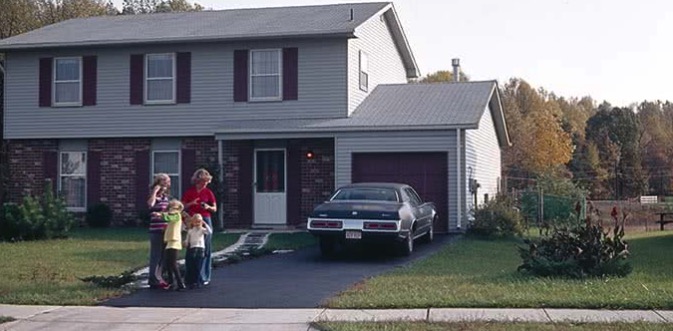
And while social media often exaggerates the past, the frustration behind those posts is grounded in something very real: many of the building blocks of a middle-class life were dramatically cheaper relative to ordinary incomes than they are today.
That doesn’t mean every family lived comfortably on one paycheck. They didn’t. But the numbers show why a single full-time income could go much further for many households than it does now.
A home cost less than twice a typical full-time man’s annual income
Housing may be the clearest example.
According to the U.S. Census Bureau, the median value of an owner-occupied single-family home in 1970 was just $17,000. Census
That same year, a man working full time, year round had median annual earnings of about $9,180, according to Census data. Census
Put those figures together and the typical home was worth roughly 1.9 times one full-time male worker’s annual income.
That doesn’t mean buying a house was effortless. Mortgage rates, down payments, geography and individual wages still mattered. But the relationship between earnings and home prices was fundamentally different.
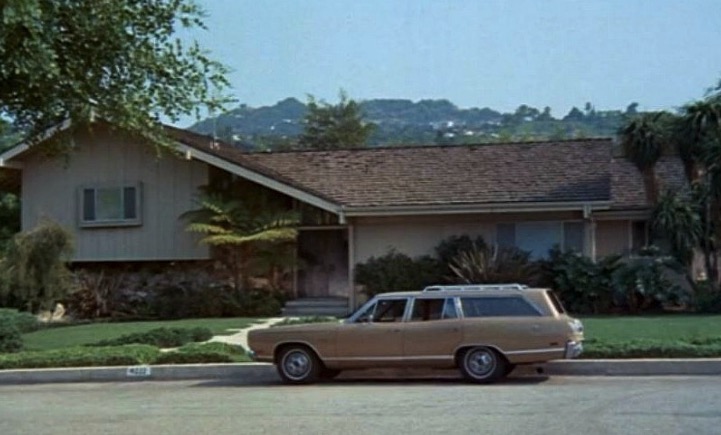
Today, that ratio is far higher.
Harvard’s Joint Center for Housing Studies found that the national median single-family home price reached roughly five times median household income in 2024. In 2022, it had climbed as high as 5.6 times household income, the highest level in records going back to the early 1970s. Joint Center for Housing Studies
Notice another important distinction: today’s comparison uses household income, which increasingly includes earnings from two adults.
In other words, even after adding a second paycheck in many homes, housing consumes far more earning power than it once did.
One-income families were genuinely common — but they weren’t the majority
This is where the nostalgic version of the 1970s needs a little correction.
It would be inaccurate to say that virtually every American family lived comfortably on one salary.
Bureau of Labor Statistics data show that in 1970 there were about 44.8 million married-couple families. Roughly 16.1 million had one earner, including nearly 14.9 million in which the husband was the sole earner.
At the same time, about 25.5 million married-couple families already had two or more earners. Bureau of Labor Statistics
So the classic one-income household wasn’t universal.
But it was far from unusual, either.
More importantly, an economy existed in which millions of households could realistically organize their lives around one wage earner without that arrangement automatically requiring an exceptionally high salary.
That distinction matters.
College was far less expensive
The same pattern shows up in higher education.
National Center for Education Statistics data show that the inflation-adjusted cost of tuition, room and board at a public four-year college in 1970-71 was approximately $5,673 in 2000-01 dollars. By 2000-01, the comparable figure had risen to about $8,655, even after adjusting for inflation. National Center for Education Statistics
Costs continued climbing in subsequent decades.
For the 2023-24 school year, NCES reported average tuition, fees, room and board of roughly $28,700 at four-year institutions overall, with substantial differences between public and private schools. National Center for Education Statistics
The result is familiar to today’s families: saving for a child’s education now competes with housing, retirement, childcare and healthcare for a much larger share of the family budget.
For many families in earlier generations, college certainly wasn’t free. But the price of attendance was less likely to require parents or students to take on enormous debts extending decades into the future.
The middle class controlled a much larger share of America’s income
The change isn’t only about prices.
It is also about where the nation’s economic gains have gone.
Pew Research Center estimates that in 1970, adults living in middle-income households represented about 59% of American adults. By 2024, that share had fallen to about 52%. Pew Research Center
The shift in income has been even more striking.
In 1970, middle-income households received roughly 62% of total U.S. household income. By 2022, their share had fallen to approximately 43%.
During the same period, the share going to upper-income households rose from about 29% to 48%. Pew Research Center
Middle-class Americans haven’t literally become poorer across the board. Inflation-adjusted household incomes have increased over the decades.
But the gains have been distributed unevenly, and some of the things families most need — particularly housing and education — have become much more expensive.
That combination is what makes today’s economy feel so different.
Workers became much more productive
There is another piece of the puzzle.
American workers produce significantly more economic output per hour than workers did 50 years ago.
Bureau of Labor Statistics data show that labor productivity has climbed substantially since the early 1970s. Real hourly compensation has risen too, but productivity and compensation have not moved upward at the same pace. Bureau of Labor Statistics
That doesn’t mean there is a single villain responsible for the gap.
Globalization, automation, declining unionization, changes in taxes and benefits, the growth of high-paying professional industries, housing shortages and the transition from manufacturing toward services have all reshaped the economy.
But the basic point remains: America became far more productive without every worker experiencing a proportional improvement in purchasing power.
The 1970s weren’t an economic paradise
It is worth remembering what the photographs don’t show.
The 1970s included severe inflation, oil shocks, recessions and unemployment.
Opportunities were also distributed very unevenly. Women and racial minorities faced legal and economic barriers that limited access to jobs, credit, housing and education. Census figures from 1970, for example, show enormous racial income disparities. Census.gov
Homeownership wasn’t universal either.
About 62.9% of American households owned their homes in 1970, meaning more than one-third did not. Census
So there is no need to pretend the past was perfect to recognize what was different about it.
What people are really remembering
The strongest version of the argument isn’t that every 1970s factory worker owned a large suburban home, two cars and sent four children to college debt-free.
The data don’t support that.
The stronger argument is simpler:
The economic distance between an ordinary paycheck and the basic ingredients of a middle-class life was smaller.
A median home costing less than twice the annual income of a typical full-time male worker created possibilities that are difficult to replicate when homes sell for roughly five times total household income.
College taking a smaller share of family resources made education easier to finance.
And an economy in which the middle class received a much larger share of total household income gave ordinary families greater participation in the country’s prosperity.
That helps explain why today’s workers can earn more dollars, live in larger homes, own better technology and still feel financially squeezed.
The issue isn’t that Americans suddenly forgot how to work.
In many households, there are now two adults working precisely because one paycheck is no longer enough to reliably purchase the things that once defined economic security.
That is the part of the old picture worth remembering.
Not because America needs to recreate 1970.
But because a society in which a normal job gives people a realistic shot at housing, family stability, education and savings is not some impossible fantasy.
We’ve built versions of it before.